


HubSpot Marketing Guide | How to Excel at Both SEO and AEO in the Age of AI
Is SEO Still Important in the Age of AI?
If you followed HubSpot’s release of the Loop Marketing strategy at the INBOUND 2025 Conference, you may have noticed a critical signal: user search behavior is shifting from traditional search engines to AI-powered conversational search.
Answer engines such as ChatGPT, Perplexity, and Gemini are fundamentally changing how users access information. When users ask questions to AI, it synthesizes information from multiple sources and delivers a direct answer—often eliminating the need to click any links.
Research shows that nearly 65% of Google searches now end in zero clicks, because answers are displayed directly on the results page.
So, is SEO obsolete? The answer is no. SEO is still essential—but it must evolve.
HubSpot clearly agrees. Recently, HubSpot officially announced its acquisition of XFunnel, an innovative platform focused on helping businesses monitor, test, and optimize AEO performance across large language model (LLM) ecosystems. This move sends a clear signal: the transition from SEO to AEO is now a required course for modern marketing teams.
However, this does not mean SEO can be skipped. On the contrary, SEO is the prerequisite and foundation of AEO—a widely accepted industry consensus and the core topic of this article.
Why SEO Is the Foundation of AEO
Before discussing how to adapt to the AI search era, it’s critical to understand one fact: answer engines still rely on web content as their source. When LLMs generate responses, they do not invent information from thin air—they extract, synthesize, and reference content from web pages.
Studies show that 76% of AI Overview citations come from pages already ranking on Google’s first page. This means:
- If your website lacks authority in search engines, AI is unlikely to reference you
- If your content structure is messy or topics are scattered, AI will struggle to understand and represent your brand accurately
- If your site lacks high-quality original content, your brand simply won’t appear in AI-generated answers
Skipping SEO and jumping straight into AEO doesn’t work. As digital agency The Get Smart Group states in its AEO guide:
“Businesses that want to rank in AI-generated answers must understand that SEO is a prerequisite for GEO and AEO. You can’t skip this step.”
SEO training platform CXL reached the same conclusion:
“A solid SEO foundation is typically a prerequisite for effective AEO.”
In other words, SEO builds the content library; AEO expands its distribution channel by enabling AI citations. They are not substitutes but sequential stages—only after doing SEO well do you earn the right to be cited in the AI era.
So how do you systematically build a strong SEO foundation?
Build a Solid Foundation with HubSpot SEO Tools
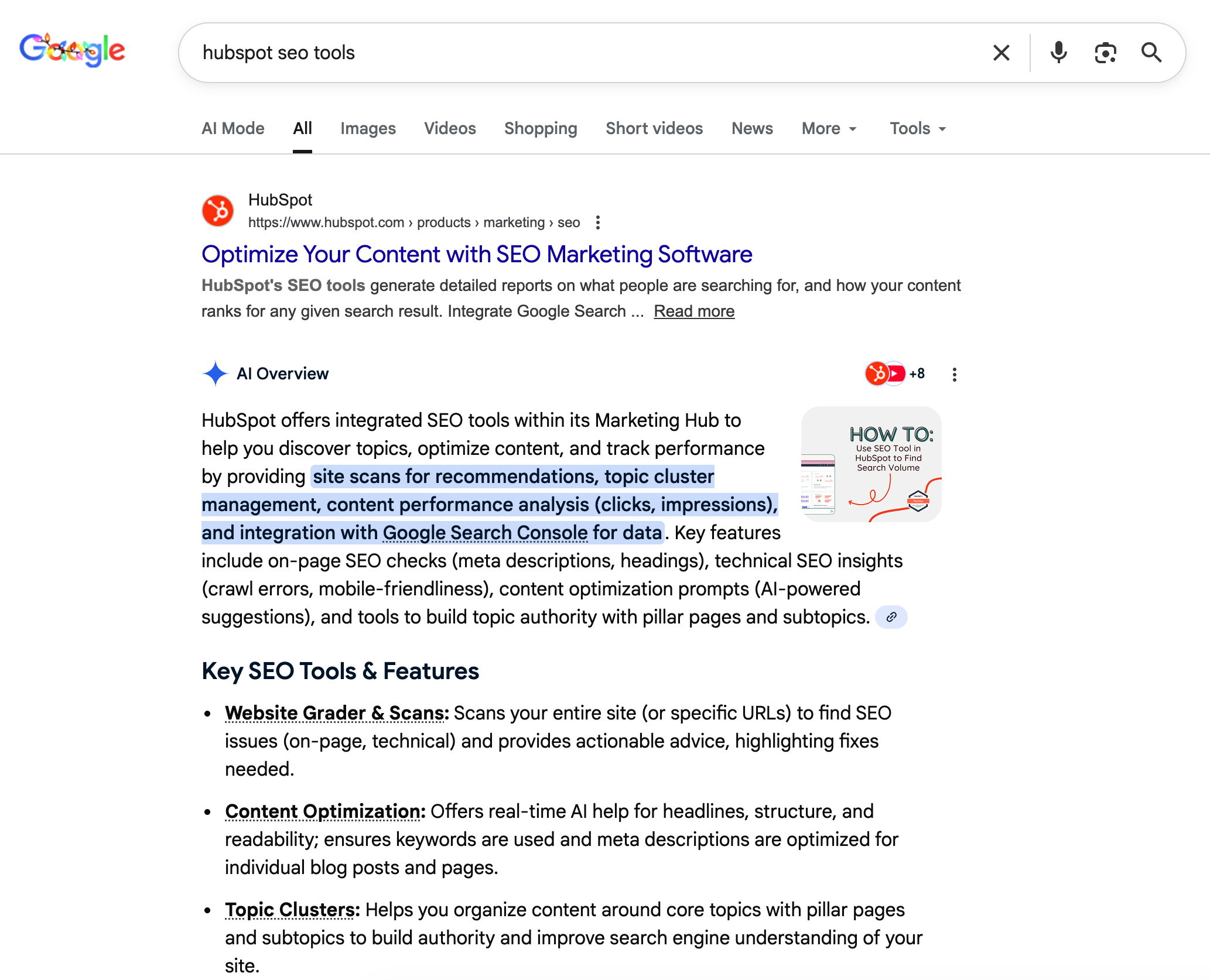
HubSpot has long embedded a comprehensive SEO toolkit within Marketing Hub, helping teams manage the entire workflow—from topic planning and content optimization to performance tracking.
Unlike standalone SEO tools, HubSpot’s key advantage lies in its deep integration with CRM, content management, and marketing automation—creating a closed loop from discovery to conversion.
Here are the five core capabilities of HubSpot’s SEO tools:
1. Topic Clusters: Building Systematic Content Authority
Search engines reward websites that organize content by topic. HubSpot’s content strategy tools make it easy to discover and rank around key themes.
📌 What Are Topic Clusters?
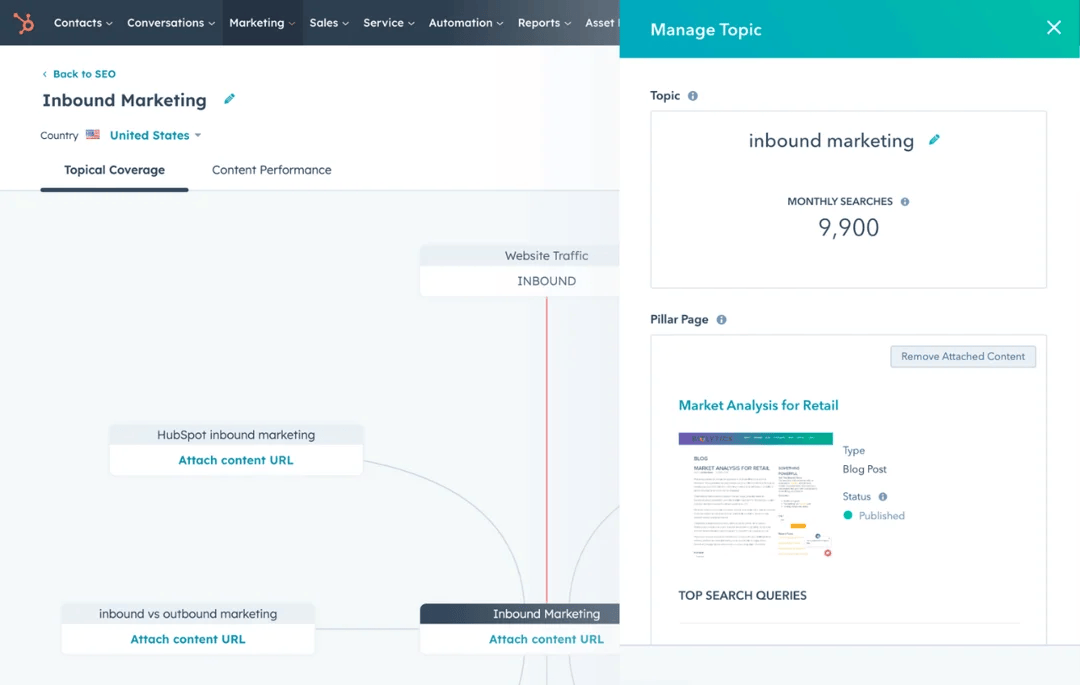
Topic clusters are the core methodology of HubSpot SEO and consist of three elements:
- Pillar Page: A comprehensive piece covering a core topic, e.g. “What Is Inbound Marketing?”
- Cluster Content: Multiple in-depth blogs related to the pillar topic, each linking back to the pillar page
- Internal Linking: A structured internal link network connecting pillar and cluster content to form topical authority
📌 Why This Matters in the AI Era
When your website builds a complete content system around a topic, search engines recognize you as an authority. AI answer engines, in turn, are more likely to cite these trusted sources when generating responses.
Topic clusters not only improve traditional rankings but also make it easier for AI to understand your expertise. HubSpot provides topic suggestions based on relevance, competition, and search demand to guide content creation around core business themes.
2. SEO Recommendations & Site Audits: Know What to Optimize First
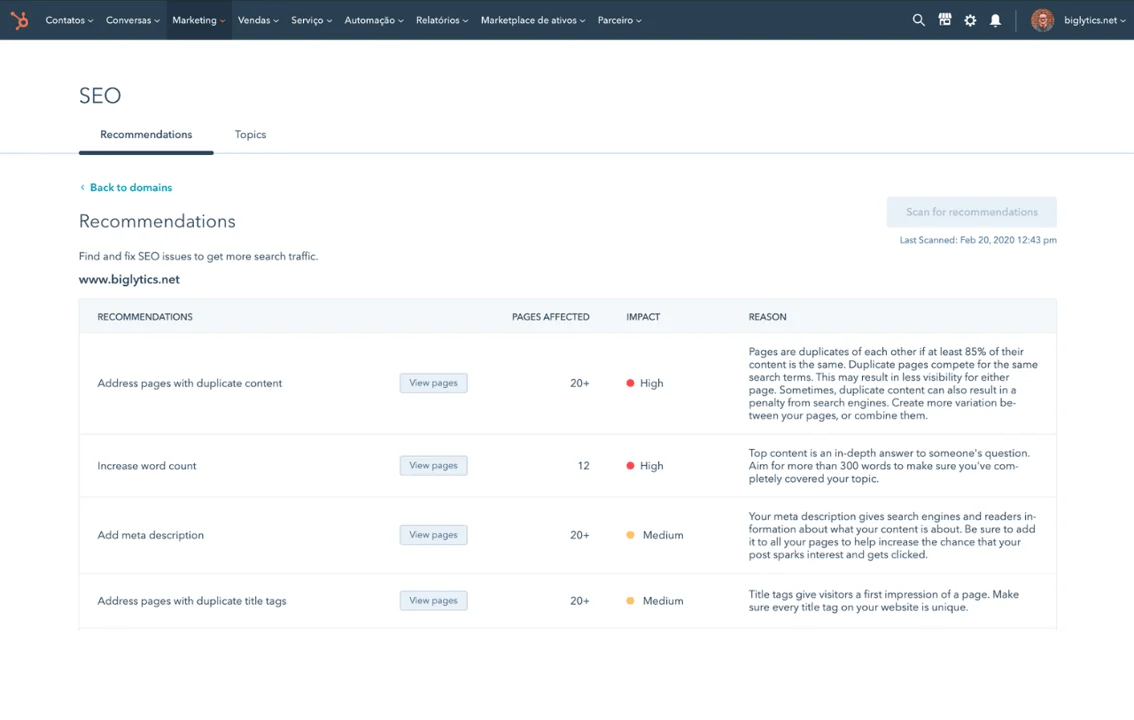
SEO rules constantly evolve, making it hard to know which optimizations matter most. HubSpot’s SEO tools:
- Automatically scan your site to identify ranking issues (e.g. long titles, missing meta descriptions, missing alt tags, slow load speed, broken links)
- Prioritize recommendations by potential impact
- Provide specific guidance (e.g. “Your title is 72 characters; shorten it to under 60”)
This clarity on “what to do first” allows teams to focus limited time on the highest-impact improvements.
3. SEO Integrated into the Content Editor: Optimize as You Write
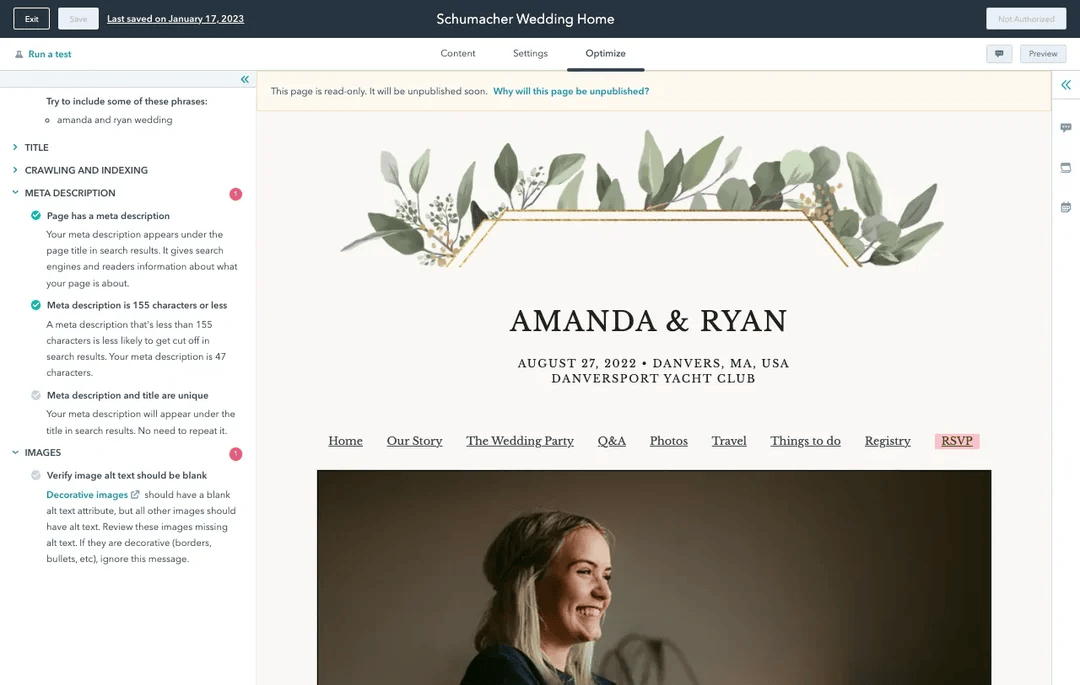
HubSpot’s SEO tools are deeply integrated with Content Hub. In the blog or page editor, clicking the “Optimize” icon in the sidebar reveals SEO recommendations for the current content.
- Title tag length
- Meta description completeness
- Keyword usage
- Heading structure (H1, H2, etc.)
- Internal linking
- Image alt tags
Each recommendation shows a completion status, helping you quickly identify gaps. HubSpot also provides AI-generated title and meta description suggestions to improve CTR.
For teams publishing content frequently, this workflow eliminates the need for third-party tools and significantly boosts efficiency.
4. Google Search Console Integration: Strategy Backed by Real Data
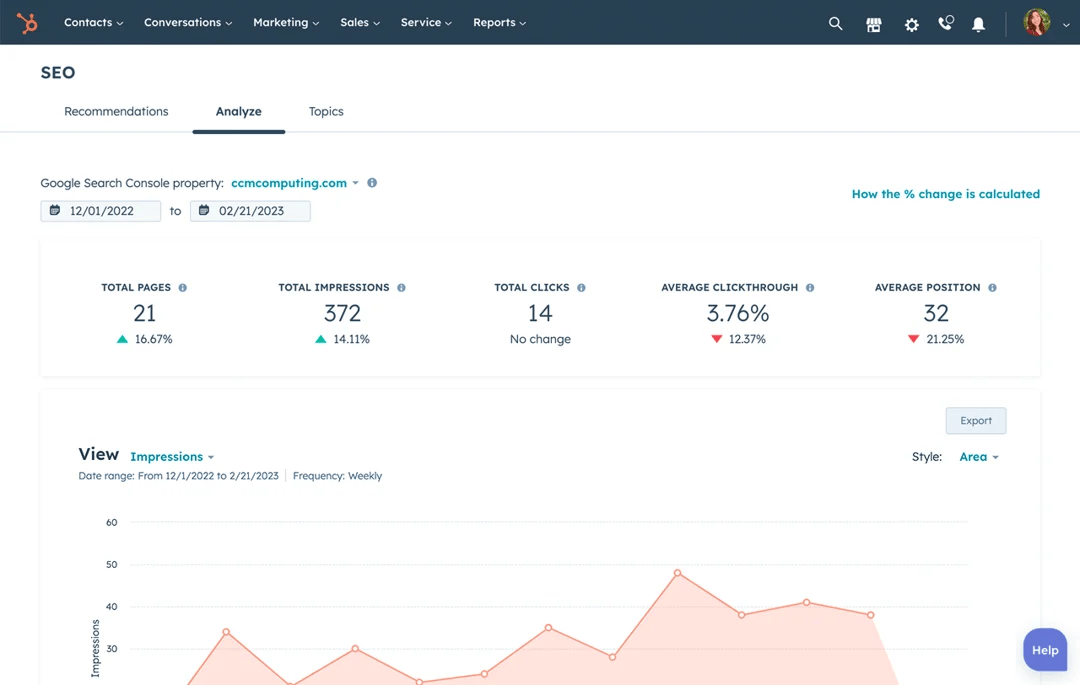
HubSpot integrates directly with Google Search Console, allowing teams to build SEO strategies based on real Google data, including:
- Search impressions
- Click-through rate (CTR)
- Actual search queries
- Indexing status
This enables data-driven decisions instead of guesswork.

5. Performance Tracking & ROI Attribution: Proving SEO Value
Most SEO tools stop at traffic metrics. HubSpot’s unique advantage is its CRM integration, enabling full-funnel tracking:
- Organic traffic volume
- Leads generated from organic search
- Revenue attributed to those leads
This “traffic → leads → revenue” visibility is critical for proving SEO ROI to leadership.
Even better, for existing HubSpot users, SEO tools are built into Marketing Hub—no need to purchase separate SEO software.
From SEO to AEO
Once your SEO foundation is solid, the next step is ensuring AI answer engines can correctly understand and cite your content—this is where AEO (Answer Engine Optimization) comes in.
AEO focuses on making content discoverable, understandable, and citable by AI platforms such as ChatGPT, Perplexity, and Gemini. Unlike traditional SEO, AEO doesn’t aim for clicks—it aims for accurate and positive brand mentions in AI-generated answers.
Key insight: SEO and AEO are not either-or choices—they are sequential. Investing only in SEO risks losing AI visibility; investing only in AEO without SEO sacrifices discovery and authority.
AEO Practical Guide: 6 Key Optimization Strategies
Strategy 1: Structure Content in Q&A Format
AI answer engines exist to answer questions. Structuring content in Q&A format is foundational.
📌 How to do it:
- Use full questions as headings
- Provide a concise answer immediately (40–60 words)
- Then expand with detailed explanations
Strategy 2: Implement Structured Data (Schema Markup)
Structured data helps AI understand what your content is about and which questions it answers. FAQ schema, in particular, significantly increases citation likelihood.
Strategy 3: Build Entity Authority
AI relies on knowledge graphs. Your goal is to be recognized as a verified entity.
Strategy 4: Optimize Content Extractability
AI extracts snippets, not full articles. Write in clear, declarative formats.
Strategy 5: Optimize for Conversational Queries
AI queries are longer and more natural-language based. Optimize for real user questions and variants.
Strategy 6: Continuous Monitoring and Iteration
AEO is ongoing—monitor citations, test answers, and refine strategies continuously.
SEO + AEO = The Complete Search Strategy for the AI Era
So—is SEO still important? Absolutely.
The right sequence is:
✅ Build SEO authority first
✅ Layer AEO optimization on top
✅ Continuously monitor and iterate
The transition from SEO to AEO is not a future trend—it’s happening now. Businesses must act today or risk being left behind in the AI era.
DKM ECO Delivers Premium HubSpot Solutions
In the era of digital growth, an AI-powered, data-connected, and fully integrated customer platform is essential. HubSpot enables businesses to achieve more with less—connecting acquisition, conversion, service, and revenue in one system.
As a HubSpot APAC Platinum Partner, DKM ECO works closely with HubSpot to deliver intelligent, efficient, and innovative marketing automation solutions worldwide.
About DKM ECO
- 🌐 HubSpot APAC Platinum Partner serving thousands of clients
- 🏆 Winner of HubSpot APAC FY2024 “Top Revenue Contribution” & “Rising Star” Awards
- 🔧 End-to-end services: HubSpot consulting, implementation, AI & automation design, CRM migration and integration
- 🏭 Serving 35+ industries including finance, tech, manufacturing, and retail
- 🌍 Operating across China, Singapore, Hong Kong, Japan, Australia, Southeast Asia, and North America
- 📊 Supporting multi-language, multi-brand, and global team collaboration
If you’d like to explore marketing automation and AI capabilities further, apply for a free HubSpot trial today.
For tailored product and subscription recommendations for global marketing needs, feel free to contact us.